
By Ernest Bako WUBONTO
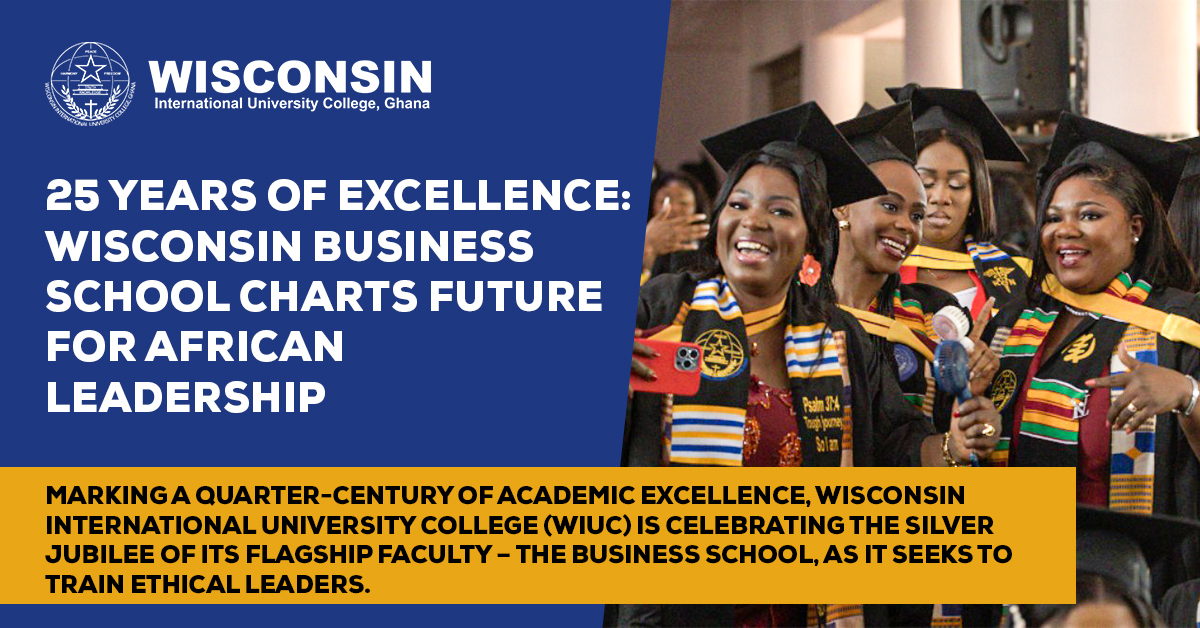
Marking a quarter-century of academic excellence, Wisconsin International University College, Ghana (WIUC-Ghana) is celebrating the silver jubilee of its flagship faculty – the Business School, as it seeks to train ethical leaders.
From its inception to becoming a powerhouse of tertiary education with campuses in Accra and Kumasi, Wisconsin has remained steadfast in its founding philosophy: that education is an indispensable asset for national survival and individual dignity.
The Chancellor of WIUC-Ghana, Dr Paul Kofi Fynn, speaking to the B&FT, reflected on the school’s journey by emphasising that the risk of an uneducated population far outweighs the challenges of producing graduates who do not get ready jobs.
He maintains that it is far better to train a graduate who is temporarily without a job than to leave a population illiterate and without prospects.
The Business School’s evocative motto, “The Future is Here,” signals a commitment to developing world-class human resources equipped to meet both local development needs and daunting global challenges.
Dr Fynn’s dream for the school has always been rooted in the belief that higher education should be accessible and transformative, making Wisconsin highly affordable among its peers in the private tertiary education space, offering numerous scholarships as well to brilliant but needy students.
“To me, education is an asset, and everybody needs to have education. A nation should have trained people with jobs rather than untrained people without jobs. So, we want to make sure Ghanaians are well-trained so that when they get an opportunity, it can be maximised,” he said.

While the university has seen a surge in interest within its Nursing, Law and IT faculties—the latter of which boasts a US$500,000 anatomy lab and cutting-edge forensic equipment, the Business School remains a cornerstone of the institution.
With a current faculty population of approximately 1,800 comprising undergraduate and graduate students, it stands as the third-largest faculty, continuing its mission to produce industry-ready leaders who combine academic proficiency with practical acumen.
Looking toward the next chapter, the Dean of the WIUC Business School, Dr. Bright G. Mawudor, highlighted a strategic shift in the school’s curriculum to produce more entrepreneurs.

Recognising that Ghana trains roughly 70,000 students annually while job growth lags, Dr Mawudor explained that the curriculum has evolved toward innovation and entrepreneurship-driven skills.
The objective is to transform graduates from mere job seekers into job creators. This is particularly vital given that 90 per cent of the school’s graduates remain on the African continent, contributing to the economies of nations such as Liberia, Ghana, Mali, Nigeria, Togo, Benin and Côte d’Ivoire.
“Our uniqueness lies in building a business school that combines African relevance with global standards. We are now heavily oriented toward innovation and entrepreneurship-driven skills. We train students not just to succeed in the job market, but to become leaders, innovators and problem-solvers who can drive Africa’s economic transformation,” he said.
The future of the business school is also being shaped by new academic frontiers. During the 18th congregation of the school held recently, the chancellor of the school indicated that the school is launching new programmes in Entrepreneurship and Innovation in affiliation with the Kwame Nkrumah University of Science and Technology (KNUST) and proposing further courses in E-Commerce, Procurement and Logistics.
This expansion aligns with a vision of building a thought-leadership centre that contributes to policy and national development.


Integrated curriculum for bridging industry gap
To bridge the gap between theory and practice, the school has cemented deep industry partnerships with professional bodies like the Chartered Institute of Marketing Ghana (CIMG), the Chartered Institute of Bankers (CIB) and the Institute of Chartered Accountants, Ghana (ICAG).
These collaborations facilitate streamlined entry into these professions and ensure the curriculum remains at the cutting edge of industry demands.
This integrated curriculum ensures that Wisconsin Ghana graduates enter the workforce with a distinct competitive edge.
These initiatives are designed to align with emerging economic trends, including the national drive toward a 24-hour economy, which the university actively supports through its focus on job creation and flexible learning options like weekend and evening MBA sessions.
Future leaders for Africa
Dr Mawudor emphasised that the ultimate goal is to cultivate leaders who combine professional competence with unwavering character to demonstrate good corporate governance and ethical leadership skills that will transform the continent.
In a continent where ethics and leadership are paramount concerns, Wisconsin Business School stands dedicated to producing the next generation of pioneers who will drive Africa’s economic transformation for the next 25 years and beyond.
“As the institution looks ahead, the core values of integrity, transparency and teamwork remain the guiding light,” he said.
Global footprint
The global value of a Wisconsin degree is evidenced by the steady stream of alumni seeking further studies abroad. Dr Mawudor noted that he signs nearly 10 recommendation letters weekly for students heading to prestigious foreign universities in Canada, the USA, Europe and Australia. This, he asserts, is a testament to the quality of tuition and the global strength of the Wisconsin brand.
The school’s uniqueness lies in its ability to blend African relevance with international standards, ensuring that, for instance, in the Law Faculty, “legal writing starts from day one” and that research and project work are central to the student experience.
CSR initiatives
The Founder of WIUC-Ghana, Dr Paul Kofi Fynn, expressed that to him, Wisconsin is a service to society and not a profit-making venture.
The university has instituted a humanitarian arm dubbed the Dada Foundation, which has embarked on numerous corporate social responsibility initiatives to support deprived communities across the country.
So far, Dada Foundation has constructed over 120 boreholes for schools and communities having water issues in the Central, Western, Ashanti, Eastern and Volta Regions. It has also constructed 12-seater toilet facilities for schools and is offering scholarships to students.
“The target is to construct 2,000 boreholes and 1,000 toilets for the underprivileged and deprived communities,” he said.
Credit: B&FT Online